A practical bookshelf sizing guide for Singapore homeowners, with room-by-room recommendations you can use before you shop.

Choosing a bookshelf should be straightforward, but sizing often turns it into a longer decision than it needs to be. You browse a few options, find one you like, and then pause. Is 80 cm wide too wide for that wall? Will a 180 cm tall unit look proportional, or will it crowd the room? Is 30 cm depth going to eat into the walkway?
These are reasonable questions, and in Singapore they come with an extra layer of complexity. Our rooms are compact, ceiling heights vary between older resale flats and newer BTOs, and there are layout quirks (bomb shelter recesses, corridor widths, aircon unit placements) that generic furniture sizing guides simply do not account for.
This guide is written specifically for Singapore flat types. It covers what to measure, what sizes are available, and practical recommendations for each room, so you have a clear picture before you commit to a purchase.
Before browsing any product page, you need three measurements from your intended wall space:
Write these three numbers down. They are your non-negotiable constraints.
Most bookshelves sold in Singapore fall within these dimension ranges. Use them as a starting point for comparison:
| Size Category | Height | Width | Depth |
|---|---|---|---|
| Low / 2-tier | 70 – 90 cm | 60 – 80 cm | 25 – 30 cm |
| Medium / 3-4 tier | 110 – 150 cm | 60 – 90 cm | 25 – 30 cm |
| Tall / 5-6 tier | 160 – 200 cm | 60 – 90 cm | 25 – 35 cm |
| Extra tall / full-height | 200 – 210 cm | 80 – 120 cm | 30 – 40 cm |
A note on depth: The standard bookshelf depth of 25-30 cm comfortably fits most paperbacks and hardcovers, which are typically 15-22 cm deep. If you plan to store A4 folders, large art books, or use the shelf for display items, look for at least 30 cm of depth.
A note on shelf spacing: The distance between individual shelves matters as much as the overall height. Standard shelf spacing is 23-30 cm. If your collection includes taller items like encyclopaedias, atlases, or vinyl records, make sure at least some shelves offer 30+ cm of clearance. Adjustable shelves give you the most flexibility here.

In a typical 4-room HDB flat, the study or spare bedroom measures roughly 2.5 m by 2.7 m to 3.0 m. After accounting for a study table and chair, your available wall space for a bookshelf is usually one wall of 2.0-2.5 m.
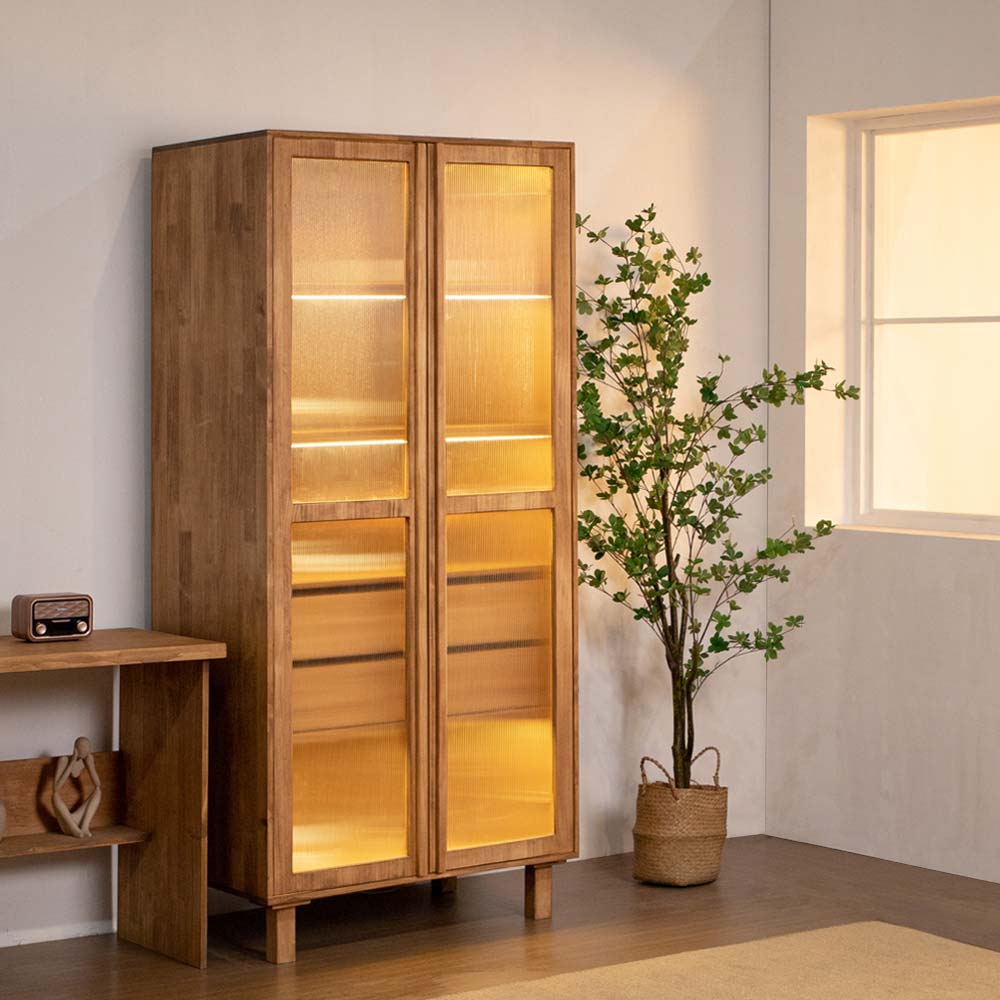
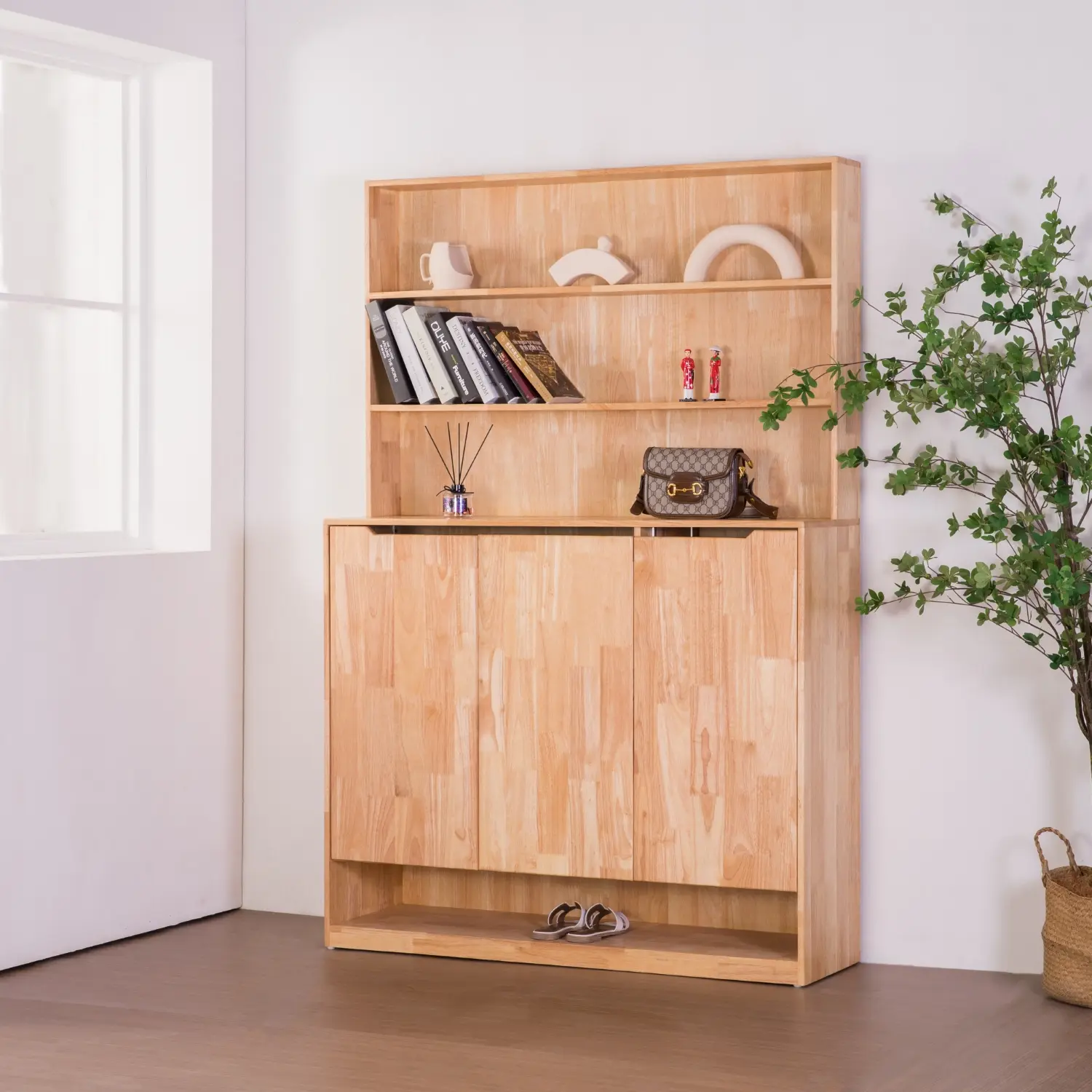
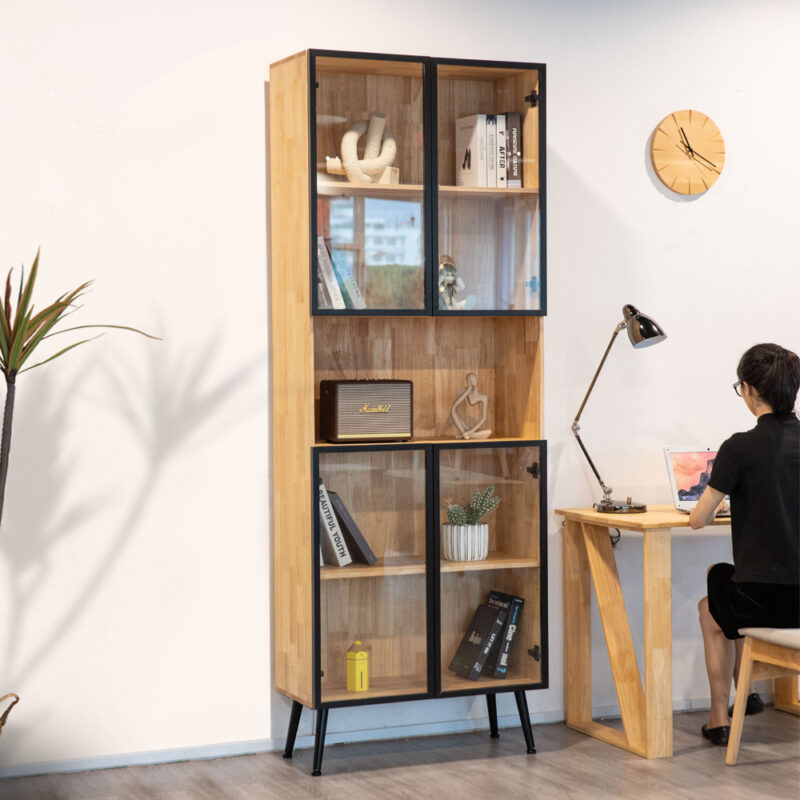
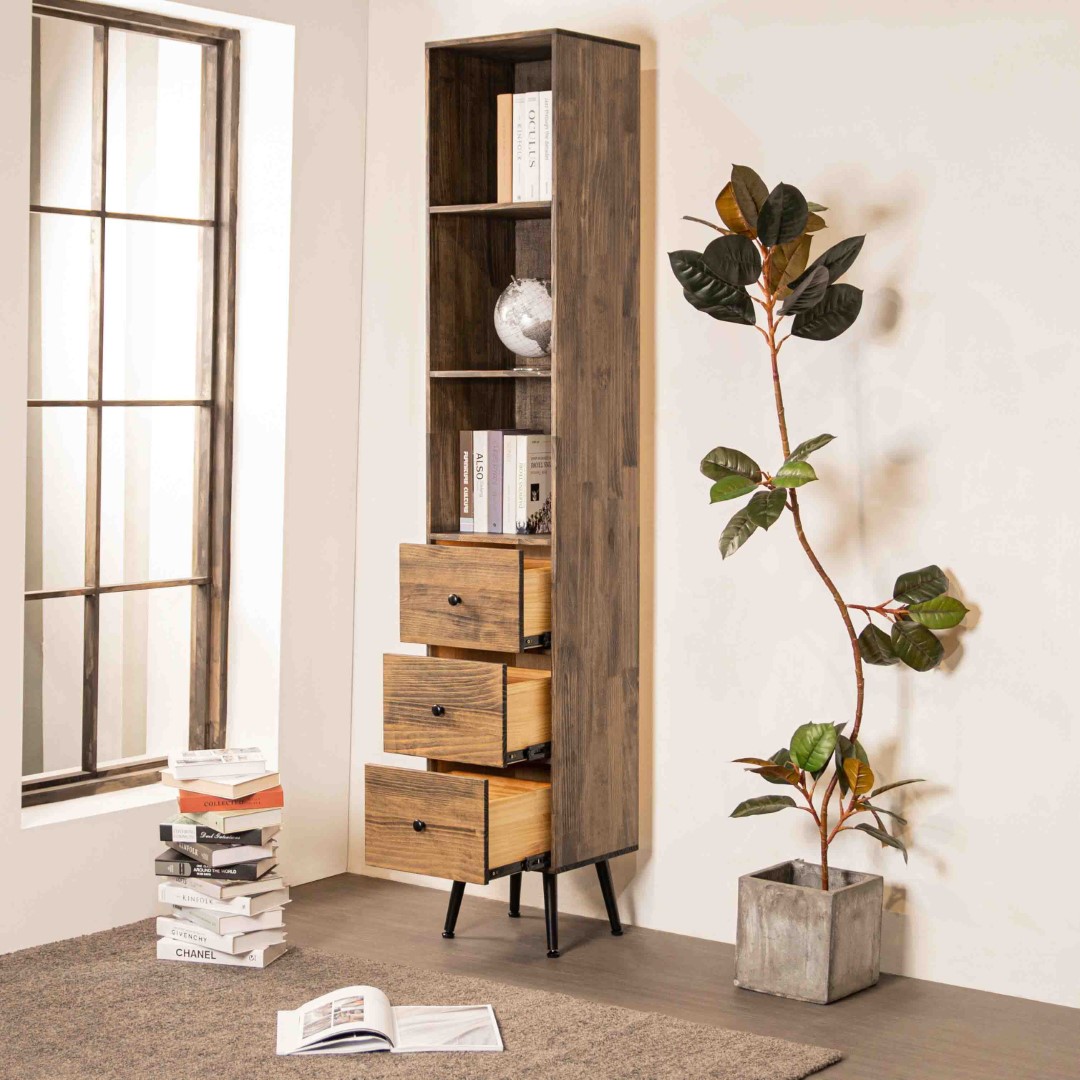
Recommended bookshelf size: A tall unit (160-200 cm high, 80 cm wide) is the sweet spot. It provides five to six tiers of storage without overwhelming the room. If the wall is long enough, two medium-width units placed side by side can create a library-wall effect while remaining individually manageable for delivery and future rearrangement.
Watch out for: The study room door swing. In many HDB layouts, the door opens inward and can clip a bookshelf placed on the adjacent wall. Measure the door arc before committing to a unit taller than the door handle height (approximately 100 cm).

Living room bookshelves in Singapore tend to serve a dual purpose: storage and display. The “bookshelf wealth” trend, which emphasises styled bookshelves as a visual centrepiece, has made the living room a popular spot for a statement bookshelf.
Recommended bookshelf size: A tall or extra-tall unit (180-210 cm) works well against a feature wall, especially if you have a 2.6-2.8 m ceiling. Wider units (90-120 cm) suit this space because living rooms typically offer more wall length. For open-plan layouts, a bookshelf can also work as a room divider between the living and dining areas. In that case, opt for a unit no taller than 150 cm to avoid visually cutting the space in half.
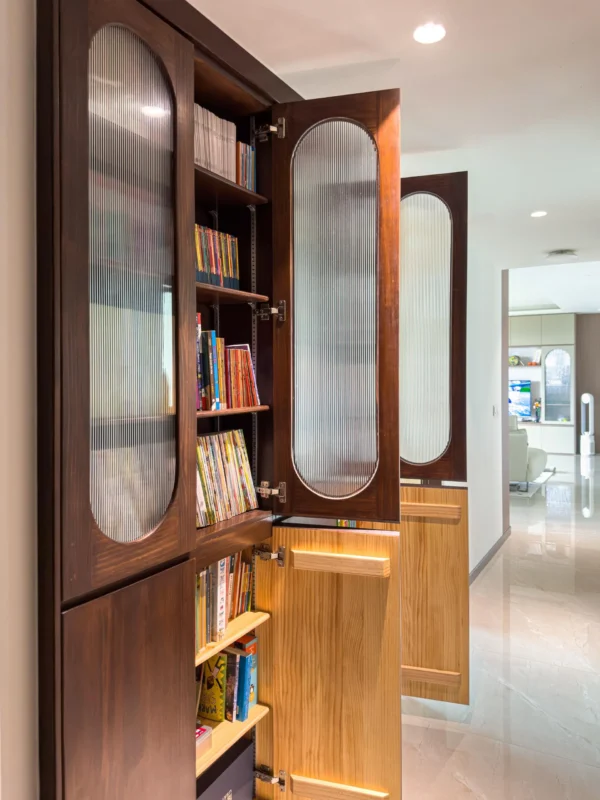
Watch out for: Proximity to windows and direct sunlight. Prolonged UV exposure will fade book spines and, over time, lighten the colour of wood finishes. If your bookshelf faces a west-facing window, consider a unit with glass doors to add a layer of protection, or position it on a wall that receives indirect light.

Safety and accessibility are the priorities here. Young children need to reach their books independently, and tall, unsecured furniture poses a tipping risk.
Recommended bookshelf size: A low unit (70-90 cm high) is safest for households with toddlers and young children. For primary school-age kids, a medium unit (110-130 cm) gives them enough shelf space for school books, storybooks, and display items while keeping the top shelf within adult arm’s reach. Whichever height you choose, anchor the bookshelf to the wall using an anti-tip strap or bracket.
Watch out for: Material safety matters more in a child’s room than anywhere else in the home. Children spend extended time in bedrooms and study areas, and furniture made from particleboard or MDF can release formaldehyde through off-gassing, especially when new. Solid wood bookshelves finished with natural wood wax avoid this issue entirely, which is particularly relevant if your child has allergies or respiratory sensitivity.

Bookshelves in bedrooms are typically used for nighttime reading collections, personal items, or as a design accent. Space is usually tight because the bed and wardrobe dominate the room.
Recommended bookshelf size: A slim, tall unit (160-180 cm high, 40-60 cm wide) fits well beside a wardrobe or in a corner. Floating wall shelves are another option if floor space is genuinely unavailable. They take zero floor footprint, though they hold less weight per shelf compared to freestanding units.
Watch out for: In many HDB master bedrooms, the air-conditioning unit is mounted on the wall above where a tall bookshelf might go. Check the clearance above your intended spot before ordering anything over 180 cm.

Some Singapore flats have a short corridor section between the living room and bedrooms that creates an otherwise dead wall space. A slim bookshelf here can convert wasted area into functional storage.
Recommended bookshelf size: Narrow width (40-60 cm) and shallow depth (25 cm max) are essential. The depth constraint is firm because HDB corridors are typically only 100-120 cm wide. A 30 cm deep bookshelf in a 110 cm corridor leaves only 80 cm of walkway, which most people find uncomfortably tight.

This is the reality for many Singapore homeowners. Walls are not always standard widths. The niche beside the bomb shelter door is an awkward 65 cm. The space under the window is exactly 112 cm, and no off-the-shelf bookshelf comes in that width.
You generally have three options:
Option 1: Choose the nearest standard size and accept the gap. This is the fastest and most affordable approach. A 5 cm gap between the bookshelf and the wall is barely noticeable once the shelf is loaded with books.
Option 2: Go with built-in carpentry. A carpenter or interior designer can build shelving that fits your wall to the exact millimetre. The trade-off is cost (typically $1,500-$5,000+ depending on scope), a longer lead time (weeks of renovation work), permanence (you cannot move it or take it with you), and the fact that most carpentry in Singapore uses plywood with laminate finish rather than solid wood. If your priority is an exact edge-to-edge wall fit with no gaps whatsoever, built-in carpentry is the way to achieve it.
Option 3: Get a custom-sized freestanding bookshelf. Some furniture makers offer made-to-order sizing where you specify the exact height, width, and depth you need. You get the precision of a built-in without the permanence or renovation hassle. The bookshelf remains a movable piece of furniture, which matters if you plan to sell the flat, move, or simply rearrange the room in the future. At Myseat.sg, for instance, our solid wood bookshelves can be customised to your exact dimensions, so you get a snug fit without committing to fixed carpentry.

A perfectly sized bookshelf is useless if it cannot get into your home. Before you order, check these access points:
If you are ordering a solid wood bookshelf, keep in mind that it will be heavier than a particle board equivalent of the same size. This is actually a quality indicator (solid wood is denser and stronger), but it means you want a seller that provides professional delivery and placement, not just a drop-off at your door. Most established furniture stores in Singapore, including Myseat.sg, include doorstep-to-room delivery and assembly as part of the service.
Before adding any bookshelf to your cart, run through this list:
If you are looking for a solid wood bookshelf that can be tailored to your space, browse the bookshelf collection at Myseat.sg. Every unit can be customised in dimensions, wood type, and colour finish. And if you are unsure about sizing, visit the showroom where our sales designers can walk through your floor plan and help you figure out exactly what fits.